Tuesday, May 31, 2011

car pushing


Car pushing

Forgotten strangeness

There’s a lot of science in training. More so everyday. And its good to know the science and the reasons behind things and why certain things happen particular ways; and how to manipulate bio mechanics to attain our goals.

But with all the newbies flooding the gyms of the world with their framed certificates in hand, quoting theory after theory, the ART of training is often forgotten.

What the theory strong trainer usually forgets (if they’re ever taught) is that practice is often miles from theory.

Car pushing must follow under the ART of training

I promise it will train every part of your body.

It will make you strong, give you endurance, condition your heart, lungs and legs, make you mentally tough.

It trains you dynamically, isometrically, hits your starting strength and maximum strength, your prolonged strength.

And it’s easy to learn. Find an open space. Find a car. Put it in neutral. Start pushing.

Car pushes are the hardest workouts my athletes have ever done.

When they start slacking in the gym I just have to remind them of the last time we went to the back of the Kmart and started pushing the car and they instantly get the right mind set.

I have been known to attach a tow rope and pull it as well.

Personally I like to work against a slight incline.

And its amazing how many people will stop and offer you help and then look on with zero understanding when you try to tell them you don’t need help. You’re training. But its good to know that some people will still make the offer.

If you can work at this for more than 20 min. Find a steeper incline.

Monday, May 30, 2011

bridging

I'd like to begin by selling you a bridge.

Okay, so its not the Golden Gate Bridge.


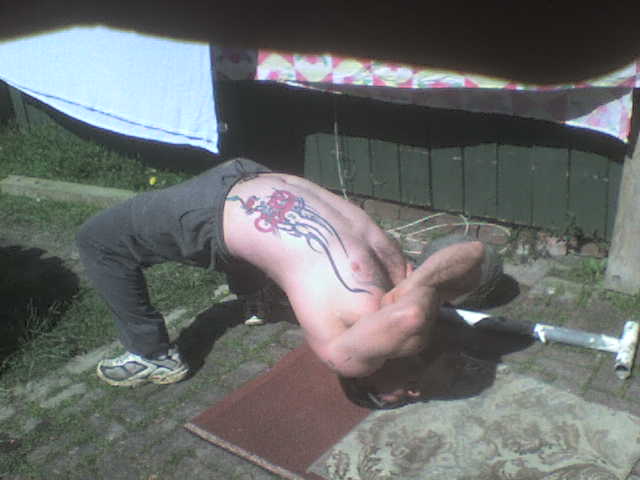
But the act of bridging and more specifically , the wrestlers bridge.


Bridging strengthens the posterior chain both dynamically and isometrically. It also drastically increases mobility, flexibility and health.


This is how your spine is designed to work. It reinforces itself in this posture.


3 ways to bridge:

1) start lying down on your back- place your hands above your head. Bend the knees and place your feet as close to your butt as you can. from there push up into a bridge position.


2) wall climbs.- I really like these. Most people think of these as a back bend, but they are not. Standing just off the wall-facing away from it-bend backwards until you can touch the wall. From there look back at the wall. you want your nose just off the wall. When you are eye to eye with the wall slowly start climbing down as far as you can. Don't slide down and don't fall down against the wall. It is a climb, climb down as far as you can and then climb back up. Your goal is to be able to place your forehead on the floor.


These are so awesome I often use these a separate movements.


3) Swiss ball. This is perhaps the easiest beginners option . Simply sit on a swissball. Roll into a lying postilion and from there reach back and roll, stretching your back across the ball. Roll back as far as you can. Once again you want to try and get your forehead on the floor.


Learn to bridge and you may forgo your weekly trip to the chiropractor.


Thursday, May 26, 2011

jump ropes

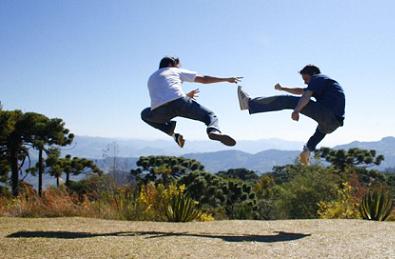
Growing up in La Florida, we always watched 'black belt theater' every saturday afternoon. Its amazing how many asian guys were named Bruce. Anyway, after the 'bbt' every kid in the neighborhood was out in the yard going over all the new moves he'd just spent the last hour and a half memorizing. Wasn't long before the staffs and numb chucks came out (always home made) with the obligatory crack to the skull. Once or twice we even had a self imposed TKO.


Starting out with jump ropes can sometimes be similar. Toes get whipped, the rope smacks you in the back of the head, I just watched rocky for the umpteenth time and tried the side to side fancy moves only to tie myself up in a series of goofy knots.
However; getting past the initial foray, jump rope is another great and all to often unused conditioning tool.
Its an excellent way to get the heart and lungs working,
Its good for recuperation and active rest.
Its great calf work
Good for coordination
Its raining and you can't go to the track? hey, lets all jump rope tonight.

One of my favourite schemes for utilizing the jump rope is as an active rest between exercises in a circuit.

Wednesday, May 25, 2011

running


I like running. Genetically speaking we were designed to run to one degree or another. (some more obviously than others).

Now, when I run, I think; I'm ususally away in fairy land during a big part of the trip. But thats me and years of RJD. I think about zombie land and the importance of cardio, I think about how much easier running was when i was a kid, I think about the business, I think about the sweat rolling into my eye and how it burns and why the hell i'm doing this and the way it collects on my lip to be blown away in a spray of breath and i wonder if maybe I shouldn't have saved that breath for, well, breathing.
I think about how long it takes me to warm up to the session and find my stride (round about the 4 min. mark usually) and then swoosh, I'm in my stide, I have my pase, and I'm paying attention to my technique. Oh; then its back to zombie land again. (unless we're running at night, then I'm on high werewolf alert.)


It doesn't matter how strong you are if you can't make it to the mail box.

The best way to run? Find a park or woodland path. Free your spirit. Start easy and slowly progress. If you're to heavy to run, find a hill, a steep hill that forces you to climb, almost crawling on hands and feet. Push a car! really-car pushing is so under utilized.


find a friend. Find someone to go with you. Put it in the diary ; monday-3:30 jogging with Joe at rags park.

You need some kind of cardio and running fits the bill. You have to train the heart and lungs too.

Monday, May 23, 2011

pullups.


deadlifts are the bedrock of manliness, but pullups are the chisel that shapes it.


no matter what size you are 20 pullups gets respect, and 20 pullups is what you should be shooting for.


my top 5 variations:

rope climb

pullup on tree branch

really damn wide

arthur jones

monkey jumps.


pullups are one of those great multi-joint total body exercises.

they hit the back, arms, grip, and if done right the core.

If you hate the gym, the only posterior upper body exercises you ever need to do are some version of the pull up.

If you're a cardio king, well, do yourself a favor and jump up into a tree along the jogging trail and get some pullups in.

got a question on pullups. ask me, i'll answer it, you should be doing them.

Tuesday, May 17, 2011

cleaning


oops, no, I mean these:

I like cleans because they require mental guts and focus. I mean they are a hard exercise, but they are easier to learn than snatches. Pull something heavy from the ground, up onto the chest. KISS.
To get strong and powerfull keep the reps between 1 and 6
to get conditioned and lean up the reps to as high as 20.
I've gone as high as 100.
ouch, I knew it too.
another great thing i like about cleans is the many different objects you can use. we use sandbags, stones, logs, kettelbells and even an old computer you can see me using if you sift through the blog.


the number 1 error I see when people do cleans is during the second pull. Instead of heaving the arms straight UP (close to the body) they turn the movement into a reverse barbell curl.


Sunday, May 15, 2011

squats


Squats; often called the king of exercises!
Another difficult exercise with a high level of skill requirement. Now don't let that desuade you from using it in your training. Its hard to find a better exercise for any goals you may have.
Squats are a more forgiving movement than the deadlift; less strenous on the system as a whole.
If you're a man this exercise is going to beef you up and make you impressive; If you're a lady this exercise is going to give you shapely legs and a nice bottom.
the stronger your squat the faster your sprint the longer you can trek.
the squat allows you to burn fat, build muscle and develop power, endurance and athletisism.
three of my favorite squat methods are:
1) 20 rep squats. If you pull of 2 sets of 20 rep squats, you're impressive. If you pull off 3 sets you really didn't do the first 2 sets properly. If you do 1 set, great, one awesome hard set of 20 reps of squating is a fantastic way to achive a lot of results. but if you're not huffn n puffn then you didn't really do them right.

I wouldn't start a workout with 20 rep squats, but you could make the squats the center of your training program (generally or for the day) or you could use it as a finisher. You should be strong though ( by that i mean, not drained from your other training) so you can give them the attention they need to provide results.

2) box squats; these are the staple of the powerlifters routine. they develop tremendous strength through the posterior chain and core and allow the trainer to go very heavy. reps should be kept under 6 reps when you practice these and technique should be focused on intently. another, often overlooked idea behind box squats for the non power lifter is the safety issue. its psychologically easier knowing you have a box behind you and the box allows more control over the depth of the squat.

(dave tate from elite fitness)
3) squating with an odd object on one shoulder: I like these. this allows one to get a strong workout with out overloading with traditional weights. technique is still important but using odd object tends to really drop the weight down. it also creates more athletic movement and cross sectional strength. A great degree of core activation. dependant upon manipulation of volume these can be used for a great mix of outcomes. I probably wouldn't use them for body building but health and fitness, strength, rehab, core work, leg work, athletisism, mma, etc, etc...
When I want a client strong and athletic these get trained.
I've done these with stones, logs, kettlebells, sandbags, even barbells.


coaching is super important in complicated lifts like squats, even when you've been squating for 30 years. without feed back and cues, you won't be getting the best of yourself. 1000lbs squaters still have a coach working on little technique points. You don't have to hire a coach , but do yourself a favour and get coaching from people who know what they are doing.